Car in Spain: re-register a car from Poland or buy locally?

Moving to Spain is not just about choosing a property, a school for the children, or organizing daily life. Sooner or later, a very practical question arises: should you take your car from Poland, re-register it in Spain, or buy a car locally right away?
What will you find in the article?
- Car with Polish plates in Spain: when does a problem arise?
- Re-registering a car from Poland: how does the process look?
- Registration tax in Spain: why does CO₂ emission matter?
- When is it worth re-registering a car from Poland?
- Leased car and moving to Spain
- Buying a car in Spain: three most common options
- ITV, DGT and gestoría – basic terms worth knowing
- Parking and fines on the Costa del Sol
- Car in Spain: a decision worth making calmly
At first glance, the answer seems simple. If we have a reliable car, know its history, and it serves us well, the natural instinct is to take it with us. In practice, however, it is worth approaching this decision like any major investment: calmly analyze the costs, formalities, time, and your lifestyle after moving.
We also discuss how buying, registering, and using a car in Spain looks in the Dream Property Talks podcast: “Car in Spain: re-register or buy locally?”.

Car with Polish plates in Spain: when does a problem arise?
For a person who comes to Spain seasonally, a car with Polish plates is obviously a natural solution. The situation is different when the stay becomes permanent and involves obtaining tax residency or effectively living in Spain for most of the year.
Then, the car used daily should as a rule be registered locally. It is not worth treating this as a minor formality. In case of inspection, collision, or contact with an insurer, questions may arise about where the owner actually lives and where the vehicle is regularly used.
The most important rule is: do not make decisions based on stories heard from friends. The deadline and possibility of using certain exemptions depends, among other things, on residency status, date of moving, type of vehicle, and its documentation. It is worth confirming your situation with a gestoría, an office specializing in Spanish administrative formalities.
Re-registering a car from Poland: how does the process look?
Re-registering a car from Poland in Spain consists of several stages. Depending on the specific car and region, they may include:
- ITV technical inspection (Inspección Técnica de Vehículos),
- verification of homologation and technical data of the vehicle,
- translations or preparation of documents,
- tax and fee settlements,
- visit to the DGT communication office,
- car insurance with Spanish plates.
In theory, this is an administrative procedure. In practice, for someone who does not know the language and local conditions, it may become an ordeal. That is why many people use the support of a gestoría, offices supporting primarily foreigners in all official matters. This is not an unnecessary cost but often a way to avoid mistakes, multiple visits to offices, and unnecessary stress.
Registration tax in Spain: why does CO₂ emission matter?
One of the most important calculation elements is Impuesto de Matriculación, the registration tax. Its amount mainly depends on CO₂ emission and the value of the vehicle.
This is where one of the most common financial “traps” appears. Many owners assume that an older car will automatically be cheap to re-register. Meanwhile, high emission and the car’s value can significantly increase the total operation cost.
Particular caution should be exercised when re-registering cars that are:
- relatively new,
- valuable,
- equipped with a large combustion engine,
- high-emission.
In such cases, tax, ITV, documentation, administrative fees, and gestoría service may make purchasing a car in Spain more economically rational.
Featured Properties
See more




































When is it worth re-registering a car from Poland?
Re-registration may make sense when:
- the car has low CO₂ emission, e.g., it is a hybrid or electric car,
- its sale in Poland would be disadvantageous,
- you know its technical history very well,
- you plan to live in Spain long-term,
- after careful cost calculation, the process is still profitable.
The most important word is “calculation.” The decision should not result solely from attachment to the car or the belief that “since I already have it, it will be cheaper.”
Leased car and moving to Spain
A leased car requires special caution. The owner of the vehicle is the leasing company, not its user. This limits the possibility of freely exporting the car, registering it in another country, or selling it.
Before moving, you should check:
- whether the contract allows long-term use of the car outside Poland,
- whether the lessor agrees to the car’s stay in Spain,
- whether buying out the vehicle is possible and profitable,
- what consequences early termination of the contract will have.
In many cases, a clearer solution is to end the lease in Poland and buy or rent a car already in Spain.
Buying a car in Spain: three most common options
1. New car from a dealership
This is usually the simplest path. The dealer handles registration, documentation, and issuing the car ready for use. It is a convenient solution, especially for people who are organizing life after moving.
2. Used car from a dealer
This is a compromise between price and safety. Dealers usually offer a warranty and help with formalities. Still, it is worth carefully reading financing terms, warranty scope, and vehicle history information.
3. Car from a private person
This option can be cheaper but requires the greatest caution. The buyer should verify both the technical and legal condition of the vehicle. Before signing a contract, it is worth checking the report in the DGT system and making sure that the car is not burdened with arrears, restrictions, or other obligations.
The purchase price must include, among other things, the property transfer tax, registration formalities, and possible repair costs after purchase.
ITV, DGT and gestoría – basic terms worth knowing
- ITV – Spanish vehicle technical inspection.
- DGT – Dirección General de Tráfico, the office responsible for road traffic and vehicle registration.
- Gestoría – an office helping with administrative, tax, and communication formalities.
- ITP – property transfer tax, which may apply when buying a car from a private person.
These terms quickly become part of the everyday vocabulary of people living in Spain.
Parking and fines on the Costa del Sol
Buying a car is one thing, daily use is another. On the Costa del Sol, a car provides great independence, especially if we live outside the strict centers of Marbella, Malaga, or Estepona. However, it is worth remembering that local parking rules are enforced consistently.
Special attention should be paid to:
- yellow lines indicating no parking zones,
- paid parking zones,
- restrictions on entering low emission zones,
- proper use of phones while driving (i.e., not using them :)),
- timely payment of fines.
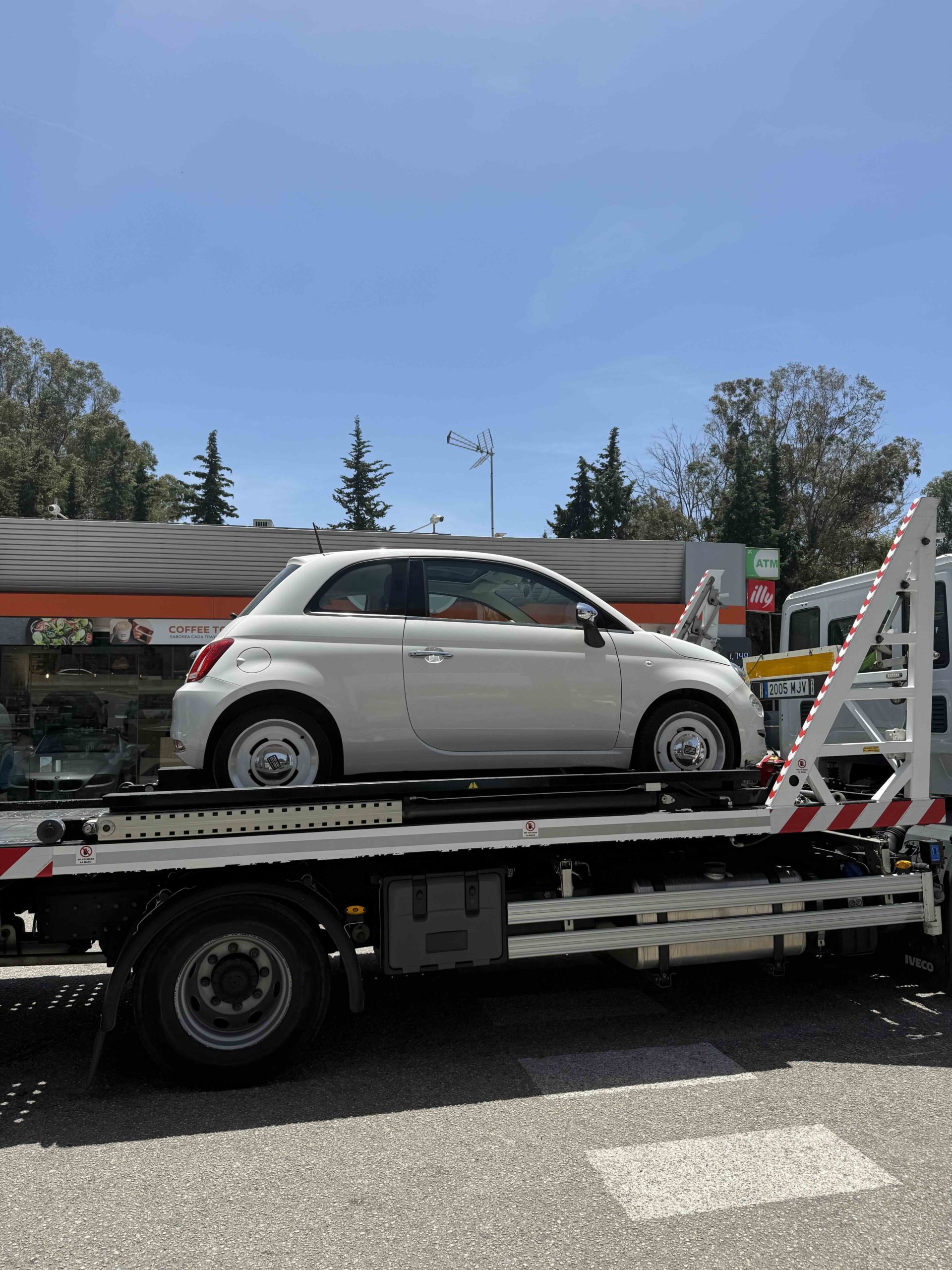
Spanish cities use towing very efficiently. If your car disappears from a parking spot, it does not always mean theft; look for it first at the impound lot. Note: the tow truck driver is not obliged or able to leave you information that your car has just been taken. If you experience a “disappearing car” event, your first steps should be to go to the nearest police station or directly to the car impound. All taxi drivers know where the nearest impound is, so just take a taxi.
Car in Spain: a decision worth making calmly
There is no single answer suitable for everyone. For one person, the most profitable will be buying a car from a Spanish dealer. For another, re-registering a hybrid they know and plan to use for years. Yet another will decide on long-term rental to initially reduce the number of matters to handle.
At Dream Property, we know that moving to Spain does not end with receiving the keys to a property. It is a whole series of decisions that affect the quality of life: school, documents, insurance, car, local services, and daily logistics.
If you plan to buy a property on the Costa del Sol or relocate to Spain, we will help you go through this process calmly, consciously, and in the right order.
Important: regulations regarding vehicle registration, exemptions, taxes, and deadlines may change, so before making a decision, it is worth confirming your individual situation at a gestoría or with a tax advisor.