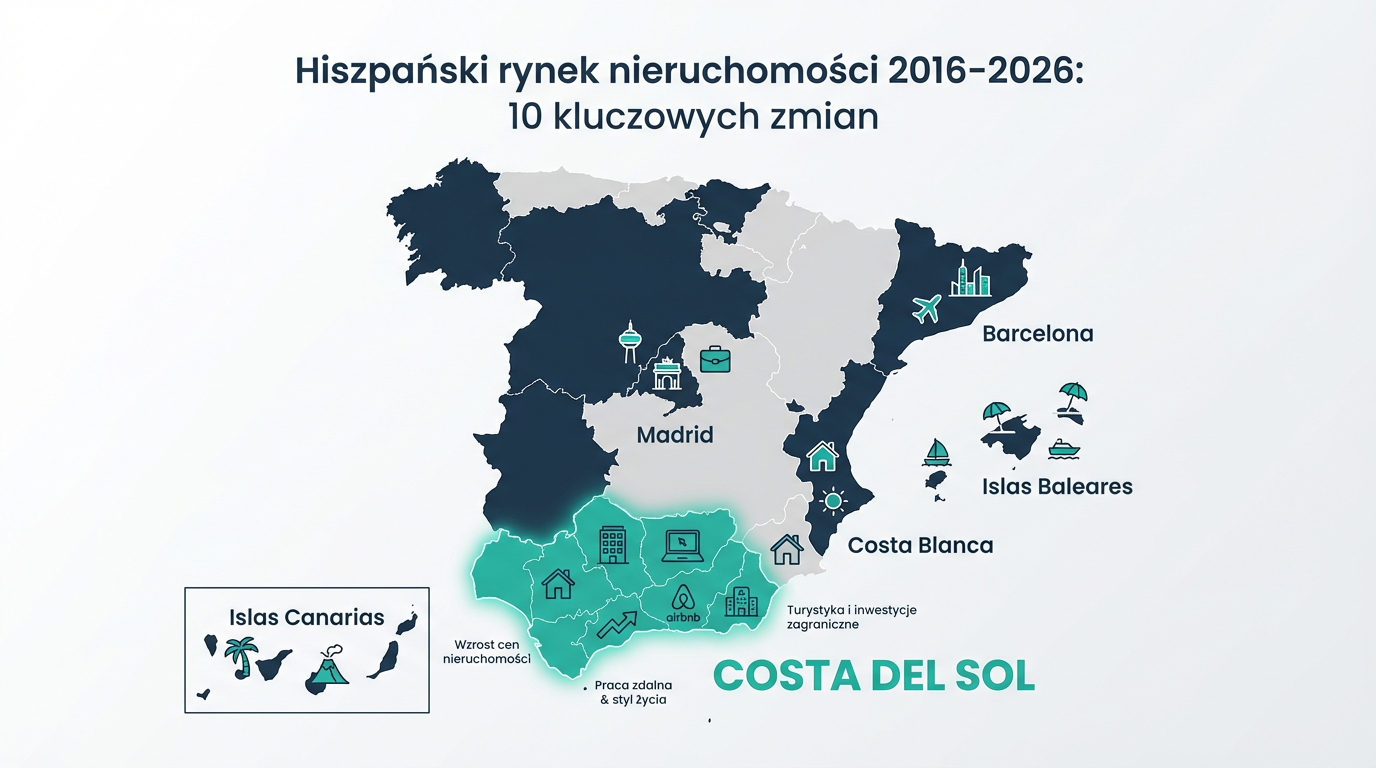
Spanish real estate market: 10 key changes from 2016 to 2026

In the last ten years, the Spanish real estate market has undergone the biggest transformation since the financial crisis. House and apartment prices in many regions have reached historic highs, the demand structure has been redefined by foreign buyers, and new regulations regarding residential and tourist rentals have changed the way private owners and investors operate in the market.
If you are considering buying property in Spain, especially on the Costa del Sol, Costa Blanca, the Balearic Islands, or the Canary Islands, these 10 trends will help you understand the world in which you are making an investment decision.
What will you find in the article?
- From crisis to record-high prices
- Dominance of foreign investors
- Remote work changes the rules of the game
- Tourist rentals: boom, social conflicts, and tightened regulations
- Stronger tenant protection and new rental law
- Energy efficiency: from formality to priority
- Spanish real estate market as a safe haven in times of geopolitical uncertainty
- End of the speculation era, beginning of the usage era
- Professionalization of international client service
- Spanish real estate market is hundreds of micro-markets
- Summary: why is this important for investors?
From crisis to record-high prices
After the market crash between 2008 and 2012, many Spanish cities entered a period of stabilization, which around 2016 turned into dynamic growth. Between 2016 and 2026, property prices recovered the losses from the previous decade and surpassed previous records. They rose especially strongly in “prime locations”: Marbella, Ibiza, Madrid, Barcelona. In the premium segment, we are talking about increases exceeding several dozen percent, and in luxury locations often much more. This is no longer a cycle, but a permanent restructuring of the price level.
Dominance of foreign investors
In many regions of Spain, especially on the coasts and islands, the share of foreign investors in the market reaches several dozen percent. The British, Germans, Italians, and Dutch remain the most active, but the last decade has also brought a significant increase in the number of buyers from Central and Eastern Europe and greater demographic diversity (younger buyers working remotely).
There has also been greater price pressure from international capital. It is precisely foreign investors driving demand for holiday apartments, villas, and modern development projects, especially on the Costa del Sol.
Remote work changes the rules of the game
The COVID-19 pandemic firmly opened the market to the so-called “living between countries.” More and more people work remotely from Spain and spend several months a year here. In this situation, of course, they need a home not only for vacations but also for daily functioning.
The Spanish real estate market quickly responded to these changes. Today’s buyers pay attention to fast fiber-optic internet, a dedicated workspace, year-round service infrastructure, and locations suitable for living 12 months a year, not just in summer.
For this reason, interest is growing in properties in year-round regions such as Marbella, Estepona, Alicante, Valencia, or Palma de Mallorca. Madrid and Barcelona also play a very important role.
Tourist rentals: boom, social conflicts, and tightened regulations
Airbnb and Booking have changed the face of Spanish cities. Between 2016 and 2026, the number of apartments in short-term rentals exploded, and rents for long-term rentals increased. This caused protests and political pressure, which led to the introduction or tightening of tourist license issuance conditions, moratoriums, or complete bans on issuing new licenses in some zones.
Today, investors must therefore consider not only price and location, but also the status of the homeowners’ association (whether it allows tourist rentals), the current municipal regulations, and the risk of future changes in the law. In some places, obtaining a license has become practically impossible, which naturally negatively affects the Spanish real estate market.
Stronger tenant protection and new rental law
Recent years have brought a series of reforms protecting tenants. These include, among others: rent increase restrictions, longer minimum contract periods, complicated eviction procedures in disputed cases, and priority tenant protection in socially sensitive situations.
As a result, owners must be more careful when selecting tenants, create better-secured contracts, and in case of problems, expect longer times to assert their rights. This changes the entire landscape of long-term rentals in Spain.
Energy efficiency: from formality to priority
Rising energy prices and EU requirements mean that buyers today look at properties not only with their eyes but also with a calculator. Important factors include: energy certificate, insulation quality, type of windows, air conditioning and heating systems, and the possibility of installing photovoltaic panels.
In new projects, standards are becoming: better insulation, energy-efficient solutions, and preparation for renewable energy sources.
The difference between old and new construction is more visible to the buyer than ever before.
Spanish real estate market as a safe haven in times of geopolitical uncertainty
Inflation, the pandemic, and the war in Ukraine have caused many investors to look for stable, tangible assets. Spain fits perfectly into this trend. It is in the European Union, has relatively stable laws, offers a high quality of life, and as a bonus, buyers get a friendly climate year-round (at least in the southern part of the country). As a result, the number of transactions motivated by capital safety, not quick returns, is increasing.
End of the speculation era, beginning of the usage era
Unlike pre-2008 times, today’s market is dominated by purchase reasons such as: a home for the family, a holiday home, a retirement home, and of course short-, medium- and long-term rentals. Buyers want comfort, good schools, infrastructure, year-round living, not just a place for quick resale. This translates into higher expectations regarding location.
Professionalization of international client service
The last decade has brought a revolution in servicing foreign buyers. Today, multilingual agencies, specialized lawyers and managers, tax advisors familiar with the needs of international investors, and comprehensive services—from NIE number to transferring utility contracts in the new home—are standard. The market has become more organized but also more complex, so working with experts is more important than ever.
Spanish real estate market is hundreds of micro-markets
The differences between regions are huge today:
- Costa del Sol ≠ Costa Blanca,
- Balearics ≠ Canary Islands,
- interior ≠ coast,
- big cities ≠ tourist towns.
These are different worlds. Each municipality may have different regulations regarding rentals, licenses, taxes, and urban policy. The “Spanish market” exists only in the media sense; in practice, one must analyze the specific city, district, and sometimes even the housing estate.
Summary: why is this important for investors?
The decade 2016–2026 is a time of huge changes: from prices and demand structure, through rental law, to the dominance of foreigners and the role of remote work. The Spanish real estate market remains one of the most attractive in Europe, but it requires greater awareness, precise analysis, and a clear plan. Buyers, both those looking for a home for themselves and investors, should look at Spain not as one market but as a complex map of micro-markets with different dynamics.